
“AI is taking over, and since we are in the digital world, you need to be abreast with whatever is in the current trends. I felt it was important to develop my digital skills and understand how to use AI responsibly.”
As AI(artificial intelligence) continues to reshape the way we work, learn, and communicate, educators are increasingly recognising the need to build the digital skills required to prepare themselves and their learners for the future of work. Through the EduBytes Basics of Generative AI & Prompt Engineering training, EduSpots equipped over 60 community-based educators with practical, responsible AI skills that strengthen teaching, improve productivity, and expand opportunities for professional growth.

One educator experiencing this transformation is Dzidedi Yaa Maloku, a basic school teacher at Attakwa T.I. Ahmadiyya Basic School in Ekumfi, an EduSpots Catalyst (community-based changemaker), and the DigiLit Strand Lead in her community.
For Dzidedi, learning has always been about staying ready for the future.
Her journey with EduBytes began long before the AI training. Previous sessions had already equipped her with practical digital skills, from creating professional CVs and résumés to using Google Forms for data collection and WhatsApp more effectively to engage fellow Catalysts and community members. These skills have not only equipped her to integrate digital tools into her classroom activities but have also enabled her to facilitate digital learning initiatives in her community to support fellow educators to also develop their digital skills.
The Generative AI and Prompt Engineering course, however, awakened a completely new level of confidence. Before joining the training, Dzidedi often found that AI tools produced responses that did not match what she needed. Like many first-time users, she assumed that simply asking a question was enough.
The training changed that perspective. Through hands-on sessions on prompt engineering, she discovered that the quality of AI-generated responses depends on the quality of the instructions provided.
“I realised that there are principles you have to follow. When you give a clear prompt, you get the effective response you are looking for.”
One of the concepts that stood out most was the Prompt Engineering framework, where participants learned to clearly define the AI’s role, assign a specific task, provide relevant context, outline any constraints, and specify the desired output format.
“Learning how to assign a role, give it a task, provide the relevant information, and specify the output format- that was my biggest takeaway.”
Dzidedi now uses AI to prepare lesson notes, design engaging classroom activities, and support the analysis of learners’ work. More importantly, she approaches AI thoughtfully and responsibly, ensuring that it enhances rather than replaces her professional judgement.
“I’ve been able to give clearer prompts so the outcomes match exactly what I need. It has helped me prepare classroom engagement activities, and even in our monthly Catalyst project-based assignments, it has helped me produce stronger deliverables.”
For educators working in underserved communities, where time and resources are often limited, these gains are significant. By learning to use AI effectively, teachers can reduce administrative workload, spend more time focusing on learners, and create richer learning experiences with the resources available to them.
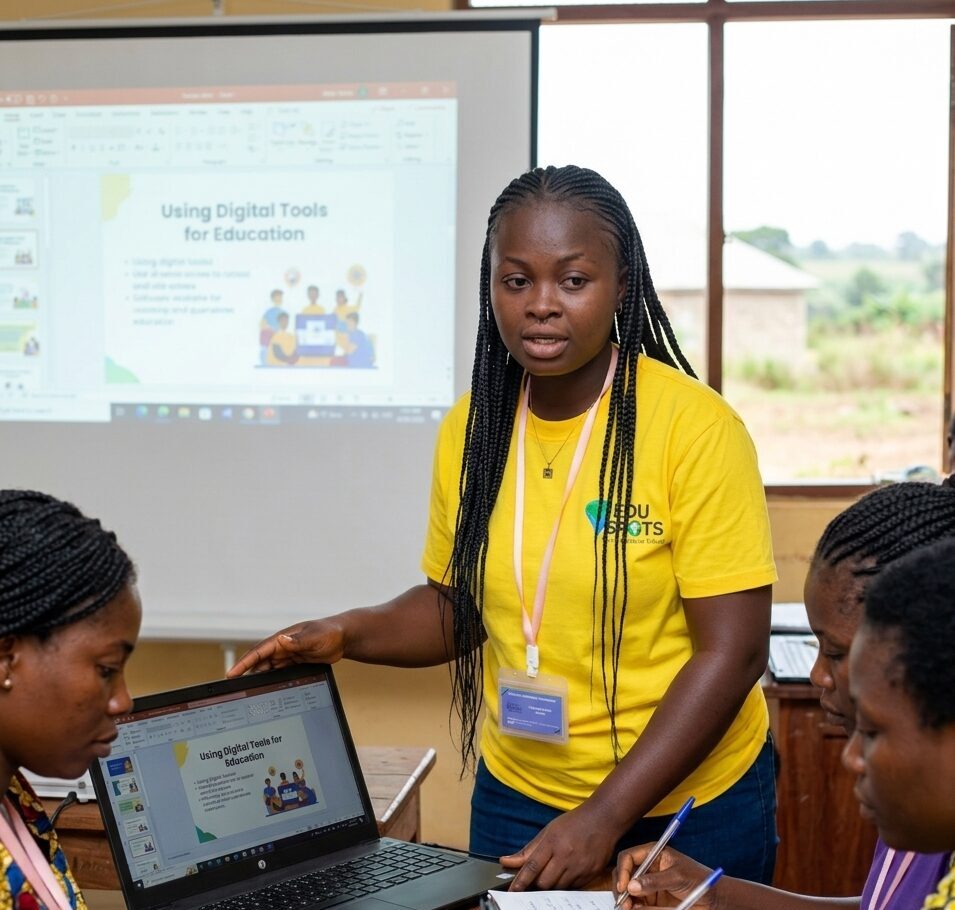
While internet connectivity remains a challenge in her community, Dzidedi is determined not to let it slow her learning. Instead, she continues exploring new ways to apply AI in her work and believes these skills will become increasingly essential for every educator.
“AI is saving us time. Tasks that would normally take a long time to organise can now be done more efficiently, as long as we use it responsibly and know how to give the right prompts.”
Beyond her own growth, Dzidedi hopes more educators, and particularly more females, will embrace opportunities to build digital skills.
“I would encourage everyone to participate in the EduBytes programme because it has become an important professional skill. And to my fellow female Catalysts, we are also capable of using digital tools to improve our work and make an even greater impact in our communities.”
Her story reflects the wider mission of EduBytes: ensuring that community leaders in the EduSpots network are not left behind as technology evolves. By providing accessible, practical, and contextually relevant digital skills training, EduSpots is empowering over 400 local changemakers in underserved communities across Ghana to become confident digital leaders who can use technology responsibly to improve educational outcomes in their communities.
As educators like Dzidedi continue to apply these new skills in their classrooms and share them with others, the impact extends far beyond a single training session. It strengthens teaching, inspires lifelong learning, and helps build communities where digital opportunities are accessible to all.
Thanks to the Eduspot EduByte team for the great impact you are making